How I won back client trust with an AI prototype
A real-data AI prototype instead of an old report, so clients finally saw something new.
Role
Senior Product Designer
Duration
Oct 2025 - January 2026
Results
96%
Retention among existing clients
41%
Increased in demo bookings in the first two weeks post-launch
4
New clients signed after launch
$10k+/month
What Beeline now sells it for, as a paid add-on
30-Second Overview
Context
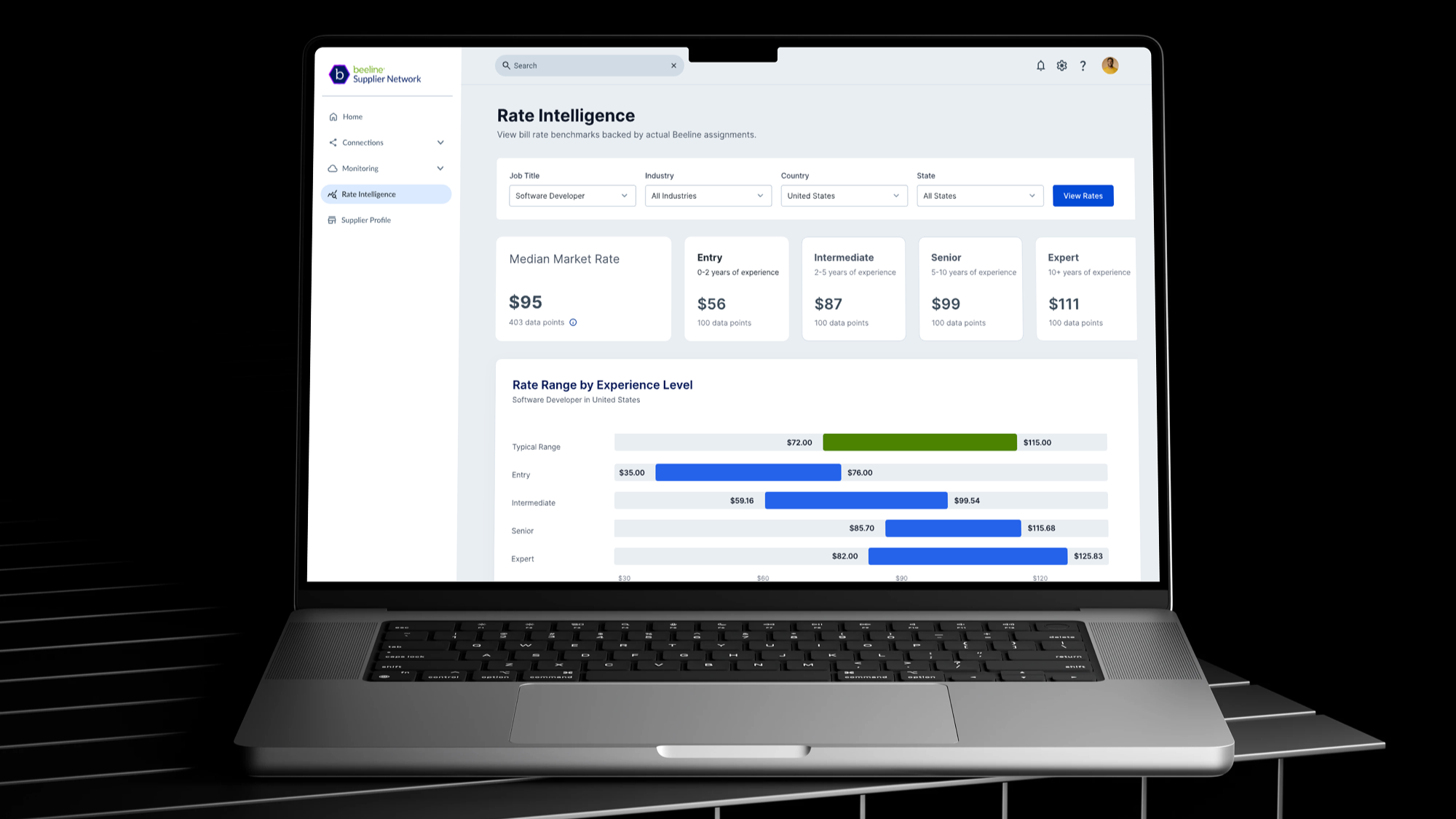
Beeline connects companies that hire contractors with staffing agencies that find them. Its promised platform rebuild was underfunded and kept getting delayed. I designed Rate Intelligence, a new feature that tells recruiters what a contract role should pay, based on 20+ years of our own hiring data.
What I Did
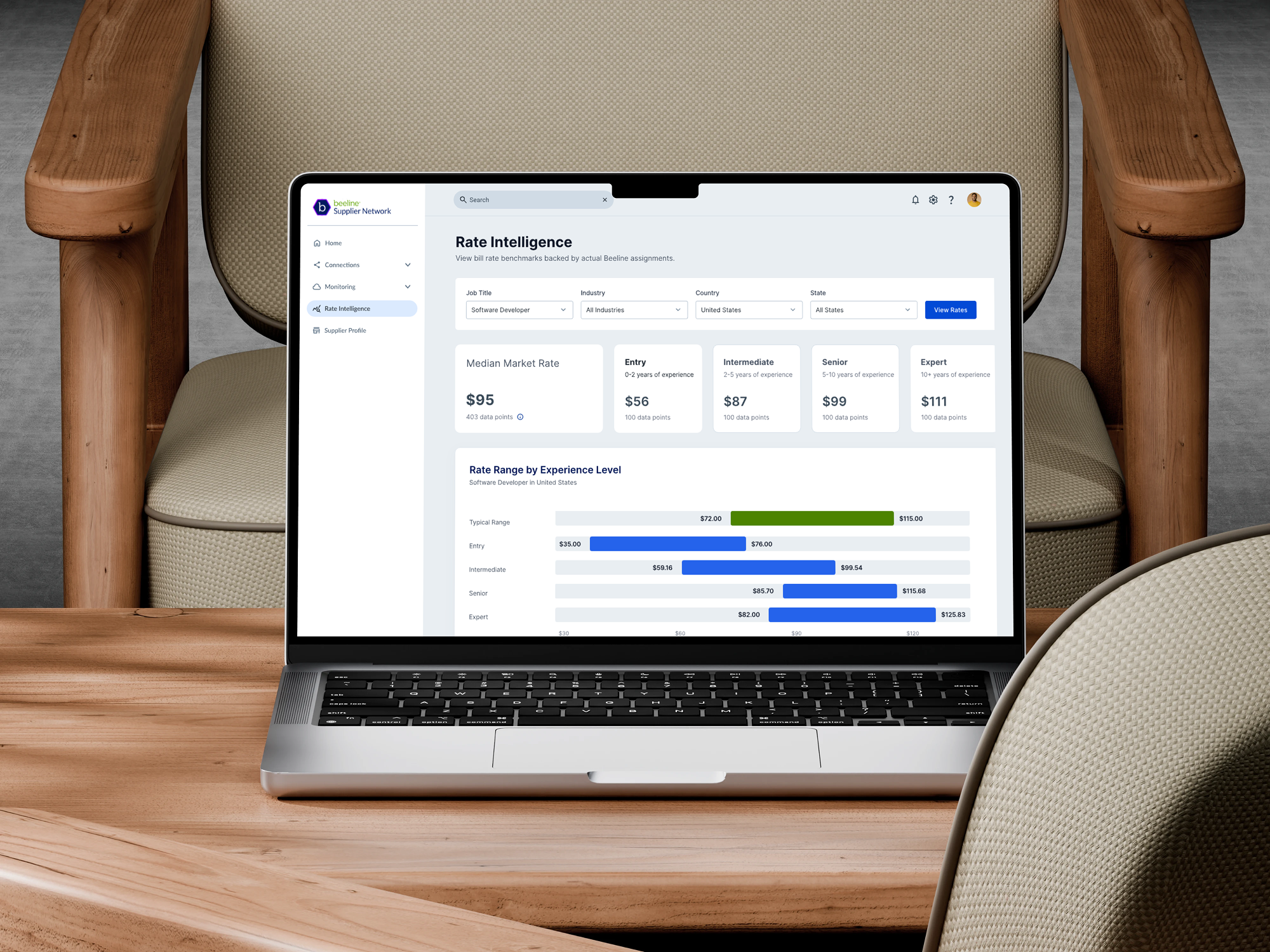
I pushed back, since an old report would tell clients nothing had changed. I built a real-data prototype in Figma Make by collaborating with our data scientist. I put the answer to every recruiter's #1 question right at the top: market rate and pay range. When AI hid charts that lacked data, we added messages explaining why, so the page never looked broken.
Problem
Rate Intelligence had to win back trust and bring in new clients. While clients waited, the connections sending job requests to recruiters kept breaking. Clients weren't renewing. To show progress, the company planned to market an old internal report as the new product.
Impact
Leadership showed it to clients before it was even built. When some wanted to wait for global data, our CEO said launch with what we have. Clients finally saw something new. 96% of existing clients renewed, and 4 new clients signed after launch.
Business Problem
Clients were angry, because Beeline had promised a new platform and hadn't delivered. In addition, the old one kept breaking, so job requests never reached recruiting agencies.
The bigger opportunity was rates. Pricing a contract role was guesswork across the industry. The main paid tool came from Brightfield. It was built largely on Beeline's own data, hadn't kept up, and cost clients $50K to $1M. Beeline had 20+ years of real rates. It could build something better and sell it for a fraction of the price.
The plan was to drop an existing Power BI dashboard into the new product because it was fast and cheap. But to clients waiting on promises, an old report said one thing: nothing had changed.
Meet Jerry, a recruiter
The UserJerry is judged on time to fill: how fast a job request goes from open to filled.
Is it even worth working on?
A request comes in for a software engineer in Tennessee at $60 an hour. His first question is, "Is it even worth working on?"
He doesn't know what the role pays, and every hour he digs, another agency gets closer.

How much goes to the candidate?
He doesn't know what engineers there make, so he digs through salary sites and calls friends. Every hour he digs, another agency gets closer to the placement.
Too little and he can't find anyone. Too much and the agency has nothing left.

Can he prove it?
He has to decide how much of that $60 goes to the candidate. The agency keeps the rest as its markup. If he offers too little, he can't find anyone. If he offers too much, the agency has nothing left. And if anyone pushes back, he needs proof.
If anyone pushes back, he needs proof.

Jerry doesn't need more data. He needs a number he can trust and send in seconds.
01.
I pushed back, then built the alternative.
Pushing back only works if you have something better. Leadership asked a fair question: can you build it fast enough? I pushed back by building an AI prototype with real data, and the near-code handoff would save developers two to three weeks. In the end, the only delay was developers waiting on cleaned data.
The Plan
Drop an existing Power BI dashboard into the new product.
Fast and cheap.
02.
I put the answers first.
Market rate and pay range sit at the top. Our data scientist wanted trends and distributions on the page too, so recruiters could answer follow-ups like "why did this pay $75 two months ago?" She was right that those questions come up. But most recruiters want a number and to get out, so her analysis lives below the fold.
Data Scientist
Trends and distributions on the page too.
For follow-ups like "why did this pay $75 two months ago?"
The Design Decision
Market rate and pay range above the fold
Her analysis below the fold.
03.
I kept it simple on purpose.
Only four filters matter: job title, industry, country, and state. Every extra filter slices the data thinner until the number stops being useful. Recruiters can export the page and send it to a candidate or hiring company as proof.
05.
I got AI unstuck
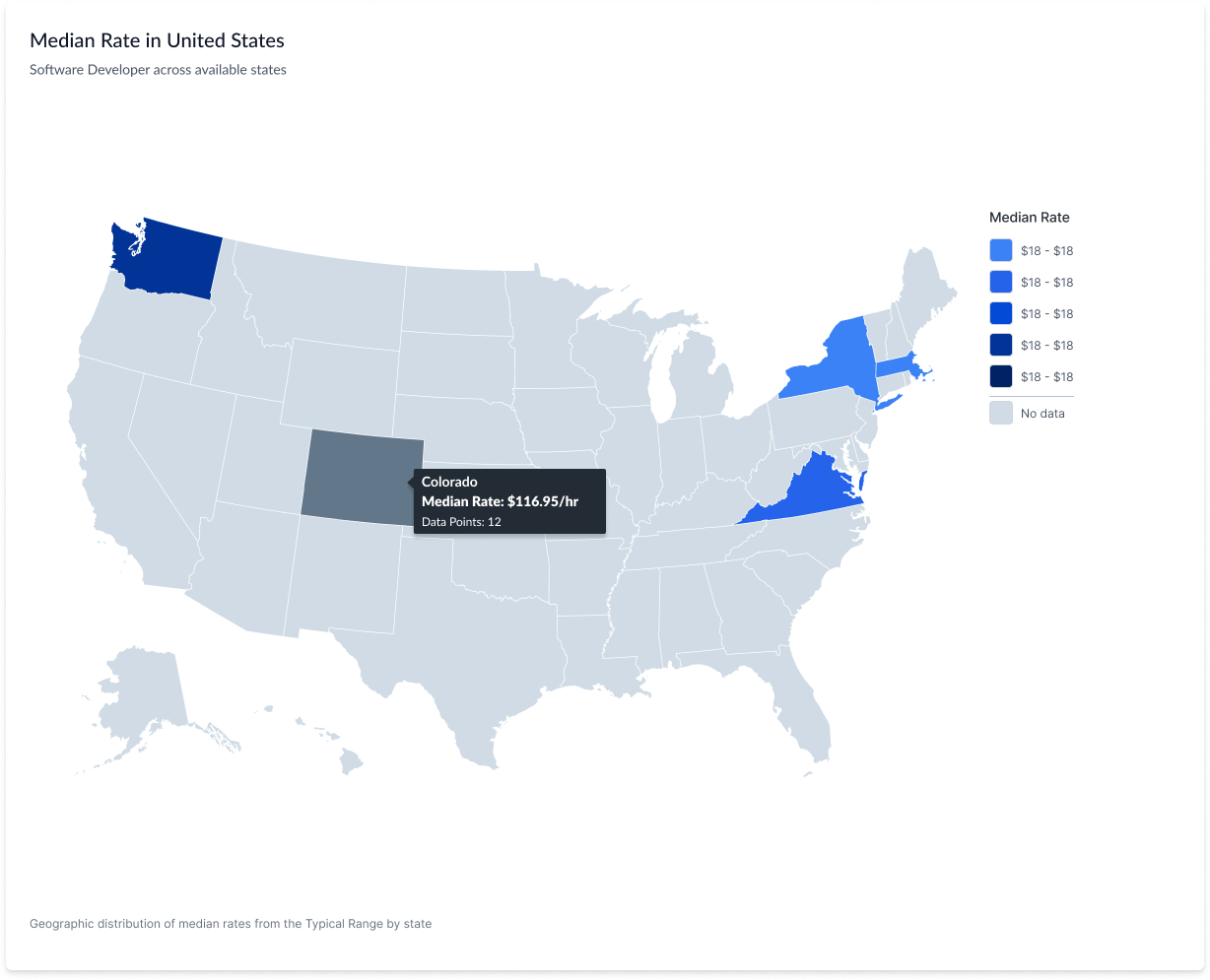
Figma Make couldn't build the heat map. It kept returning distorted images of old maps. I switched to developer language and simplified the prompt, then dug into charting documentation and found the right term: a choropleth map. Once I asked for it by name and gave it an SVG outline of the US, it worked.
The Design Decision
Build an AI prototype with real data.
With a near-code handoff for developers will save 2-3 weeks.

04.
I decided what AI would do, and what I would..
Security wouldn't let our design tools touch company data, so our data scientist and I exported real data instead. I used ChatGPT to write a detailed Figma Make prompt up front, designed the layout myself, and let AI build the charts. Over two weeks of working sessions, I prompted and our data scientist checked every chart.
Design SolutionDesign Decisions
REFLECTIONSLooking Back
Getting leadership sign-off was the real bottleneck on this project, not the design work itself, so part of my job was building the case, not just the interface: framing the survey data and prototype clearly enough that approval was a fast "yes" rather than a drawn-out negotiation.
Working alongside our data scientist also sharpened how I think about ownership. She translated raw numbers into reasoning; I translated that reasoning into something people could act on without misreading it. That overlap taught me that whoever touches this data, on either side of the interface, needs full context, or numbers could be misread.
If I could rewind, I'd push for a clickable prototype early enough to A/B test the motion and layout calls I had to lock in to hit the release date.